Malcolm Gladwell sits down with IBM Chairman and CEO Arvind Krishna in a special live episode of Smart Talks with IBM. They discuss the groundbreaking potential of quantum computing, the transformative impact of AI on business, and how Krishna’s visionary predictions from the 90s continue to guide IBM’s innovations.
To deploy responsible AI and build trust with customers, businesses need to prioritize AI governance. In this episode of Smart Talks with IBM, Malcolm Gladwell and Laurie Santos discuss AI accountability with Christina Montgomery, Chief Privacy and Trust Officer at IBM. They chat about AI regulation, what compliance means in the AI age, and why transparent AI governance is good for business.
In deze aflevering schuiven twee gasten aan om de complexiteit van AI in de financiële wereld te bespreken. We praten met Onur Koltukcu van De Nederlandsche Bank, strateeg op de beleidsafdeling, met AI als dé kern van zijn werk.
De voordelen van een AI-gedreven org chart
Door AI Agents in te zetten binnen de organisatie krijg je aanzienlijk meer flexibiliteit. Bedrijven kunnen sneller schakelen omdat taken dynamisch worden verdeeld op basis van capaciteit en prioriteit. AI Agents werken continu, zijn onbevooroordeeld en kunnen snel leren van nieuwe data. Daardoor verlopen processen soepeler en is er minder menselijke foutgevoeligheid. Bovendien kunnen medewerkers zich richten op creatieve en strategische taken terwijl de AI Agents de uitvoering overnemen.
Dit draagt bij aan meer efficiëntie en snellere besluitvorming. Met een AI-gedreven organigram worden werkplekken flexibeler: functies veranderen mee met de actuele behoeften en de bedrijfscultuur beweegt zich richting een intelligente, autonome samenwerking.
Uitdagingen en kansen voor AI Agents
Voor veel organisaties is de overstap naar een volledig AI-gedreven structuur nieuw terrein. Belangrijk is om heldere kaders te scheppen over welke taken AI Agents mogen uitvoeren en waar menselijk toezicht nodig blijft. Ook de integratie met bestaande IT-systemen vraagt aandacht. Niet elke taak is geschikt voor volledige automatisering, dus een hybride model van mens en AI Agent is vaak een logische tussenstap. Toch is de potentie groot. AI Agents kunnen alvast geavanceerde analyses doen, support taken oppakken en zelfs klantcommunicatie verzorgen. Door stap voor stap reële toepassingen te integreren, groeit het vertrouwen in een autonome samenwerking. Dit leidt uiteindelijk tot een concurrerender, wendbaarder bedrijf.
De rol van watsonx in het nieuwe werklandschap
IBM watsonx speelt een belangrijke rol als platform voor AI Agents. Het biedt een krachtige combinatie van AI- en datatechnologie die organisaties helpt om AI Agents veilig, schaalbaar en effectief in te zetten. Watsonx maakt het mogelijk om modellen te trainen, beheren en continu te verbeteren, passend bij de specifieke behoeften van jouw bedrijf. Hiermee ondersteunt het sneller en flexibeler opereren zonder de menselijke regie te verliezen.
Copaco als partner in digitale transformatie
Wanneer je deze transformatie overweegt, is het belangrijk om de juiste technologie en expertise in huis te halen. Wij denken graag mee over een toekomstbestendige aanpak met innovatieve AI-technologieën. Door gebruik te maken van betrouwbare oplossingen die flexibel integreren met jouw huidige infrastructuur, helpen wij jouw organisatie sneller en slimmer te werken.Denk hierbij niet alleen aan AI Agents zelf, maar ook aan de achterliggende platformen die deze autonoom aansturen. Zo blijft de controle gewaarborgd en is de overstap beheersbaar.
Wil jij meer weten over hoe AI Agents jouw organisatie kunnen transformeren? Neem contact op met Copaco en ontdek hoe je met de juiste technologie en expertise vandaag al toekomstbestendig kan werken. Samen bouwen we aan een slimme, autonome werkplek.
AI-systemen worden steeds beter en kunnen indrukwekkende resultaten leveren. Ze helpen organisaties efficiënter te werken en bieden nieuwe inzichten. Toch betekent bijna perfecte AI niet dat je blindelings op deze systemen kunt vertrouwen. Zonder de juiste waarborgen kunnen zelfs kleine fouten leiden tot grote en soms zelfs catastrofale gevolgen. Daarom is het belangrijk om naast het nastreven van optimale prestaties juist ook scenario’s van falen goed in te plannen en te beheersen.
De illusie van onfeilbare AI door prestaties te vertrouwen
Moderne AI heeft indrukwekkende accuratesse en snelheid. Dit maakt dat veel gebruikers denken dat de AI altijd juist zal handelen. Maar AI-modellen zijn nooit foutloos. Ze leren op basis van data en statistiek, wat betekent dat ze in onvoorziene situaties kunnen falen. Daarnaast kunnen biases in data zorgen voor onwenselijke uitkomsten, of kunnen veranderingen in de omgeving het model buiten zijn kennisgebied brengen. Door alleen te focussen op de prestaties en signalen zoals hoge nauwkeurigheid, negeer je de risico’s die verbonden zijn aan falen.
5 stappen om falen te voorkomen:
Een realistische aanpak begint met het aanvaarden dat falen mogelijk is en hier op voorbereiden. Dat kan door:
Failsafes en menselijke controles in te bouwen. AI mag ondersteunen, maar beslissingen met grote impact vereisen altijd een menselijke check.
Monitoring en feedbackloops te implementeren, zodat afwijkend gedrag snel wordt gesignaleerd en gecorrigeerd.
Robuuste testscenario’s te ontwerpen die ook zeldzame of extreme situaties simuleren.
Transparantie in AI-modellen te bevorderen, bijvoorbeeld via uitlegbare AI, zodat beslissingen te herleiden zijn.
Continu verbeteren op basis van nieuwe data en inzichten.
Door deze maatregelen voorkom je dat een bijna perfect werkend AI-systeem fouten maakt die grote gevolgen hebben voor het bedrijf en het vertrouwen.
De rol van digitale transformatie en AI governance
Digitale transformatie draait om het benutten van technologie om businessprocessen beter te maken. AI speelt hierin een belangrijke rol, maar succes hangt af van goede governance en risicomanagement. Bij Copaco zien we dat organisaties investeren in een heldere strategie waarin prestaties én falen in balans worden gebracht. Daarbij hoort ook het combineren van AI met menselijke expertise en heldere afspraken over verantwoordelijkheden. Dit voorkomt dat AI een blackbox wordt waar niemand meer de controle over heeft.
watsonx als partner voor betrouwbare AI
Bij Copaco ondersteunen we organisaties met innovatieve oplossingen zoals watsonx, een geavanceerd AI-platform dat mogelijkheden biedt voor het ontwikkelen, trainen en beheren van AI-modellen. Watsonx helpt bij het creëren van AI die niet alleen hoge prestaties levert, maar ook transparant en controleerbaar is. Het platform biedt tools om AI-systemen continu te monitoren en te beveiligen tegen onverwachte fouten. Zo kun je als organisatie vertrouwen op AI, zonder de risico’s te onderschatten.
Conclusie: vertrouwen is goed, plannen voor falen is beter
AI is een krachtige technologie die veel kansen biedt, maar is nooit perfect. Vertrouw daarom niet blind op bijna perfecte AI. Bouwen aan een veilige en succesvolle AI-omgeving betekent ook altijd plannen voor het onverwachte, met waarborgen, controles en transparantie. Zo vermijd je ernstige fouten en behoud je het vertrouwen van stakeholders. Wil je weten hoe je AI verantwoord en effectief inzet? Wij helpen je graag op weg met de juiste kennis en tools.
Neem contact op met Copaco voor advies over betrouwbare AI-oplossingen en digitale transformatie.
Deze keer schuift Frank Ketelaars bij ons aan tafel. Frank is IBM Distinguished Engineer voor het Data Platform en werkt veel met AI. Vandaag bespreken we alles rondom Agentic AI, wat er mogelijk is en hoe de toekomst er uit komt te zien.
Of te wel, vibe coding, prompt tuning, probabilistic applications, AI agent tools, verschillende LLMs, AI orchestrator en niet te vergeten de data die hiervoor nodig is.
Weer een hele leerzame aflevering! Luister snel.
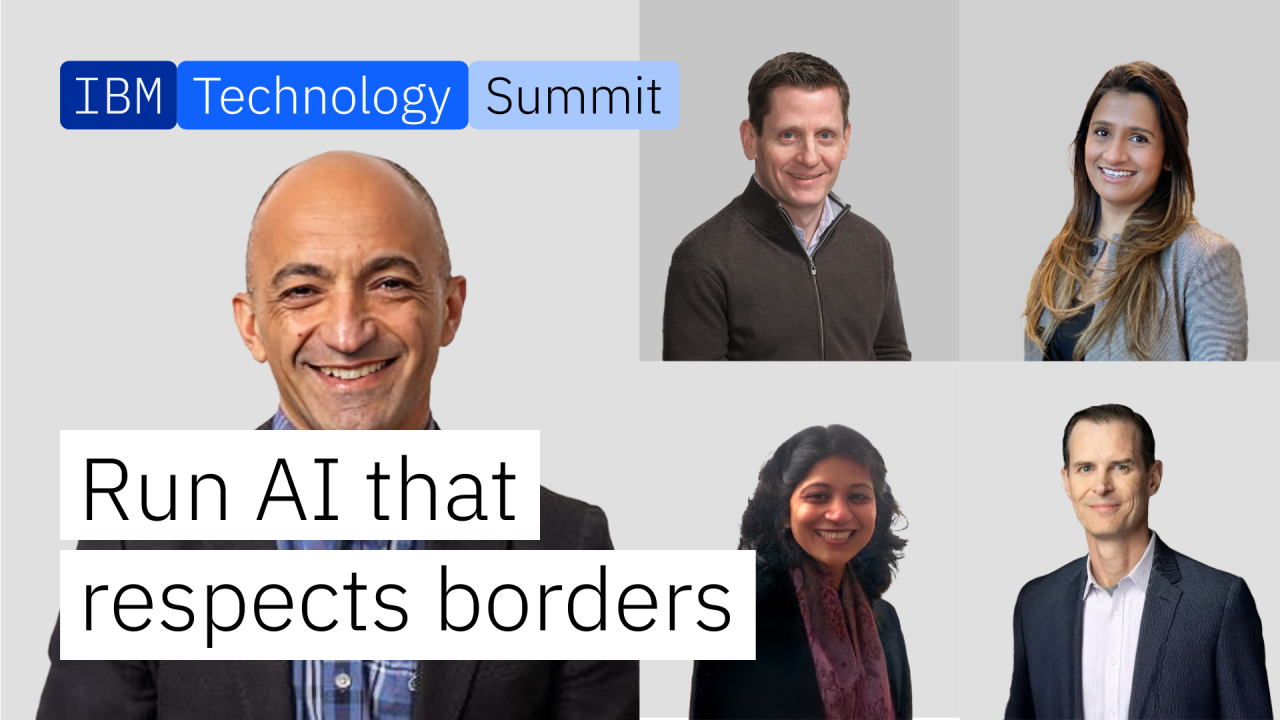
Run AI that respects borders—sovereign, compliant and under your control
AI is redefining how enterprises operate—and where their data, models, and workloads can live. This IBM Technology Summit session explored how organizations are navigating the growing demands of digital sovereignty and what it takes to deploy AI securely, compliantly, and at scale without slowing innovation.
In this episode of the IBM Technology Summit, Rob Thomas, IBM SVP Software and Chief Commercial Officer, joined Bruno Aziza, Vice President of Marketing, IBM Software, along with Priya Srinivasan, General Manager, IBM Software Products (Core & ALM), Will Streit, Vice President, IBM Software – Security, Sterling, and ELM, and Shikha Srivastava, Distinguished Engineer and Master Inventor, IBM SWG MultiCloud SaaS Platform, to examine how AI is accelerating the need for digital sovereignty—and how enterprises can respond.
Rob outlined his vision for IBM Software in 2026 and beyond, and Priya explained why digital sovereignty has become a strategic imperative for organizations operating across regulated and multi-cloud environments. Together, they unpacked why this moment represents a fundamental shift in how enterprises think about control, compliance, and innovation.
The session concluded with an exclusive preview of IBM Sovereign Core, IBM’s AI-ready sovereign foundation. Will and Shikha walked through how IBM Sovereign Core is built on an open-source foundation, delivers continuous compliance and transforms AI-ready sovereign environment deployment from months to days—giving enterprises end-to-end control without sacrificing speed.
See how IBM is redefining digital sovereignty for the AI era.
Successful implementation of artificial intelligence (AI) is contingent on an AI strategy that takes into account the following considerations:
Open: It’s based on the best open technologies available
Trusted: It’s responsible and governed
Targeted: It’s designed for the enterprise and targeted for business domains
Empowering: It’s designed for value creators, not just users
Designed with these elements in mind, watsonx is a new AI and data platform that empowers enterprises to scale and accelerate the impact of AI across the business by leveraging data wherever it resides. IBM software products are embedding watsonx capabilities across digital labor, IT automation, security, sustainability, and application modernization to help unlock new levels of business value for clients.
The watsonx platform has three components: watsonx.ai (now available), watsonx.data (now available) and watsonx.governance (expected availability in November). In this blog, I will cover:
What is watsonx.ai?
What capabilities are included in watsonx.ai?
What is watsonx.data?
What capabilities are included in watsonx.data?
How can you get started today?
What is watsonx.ai?
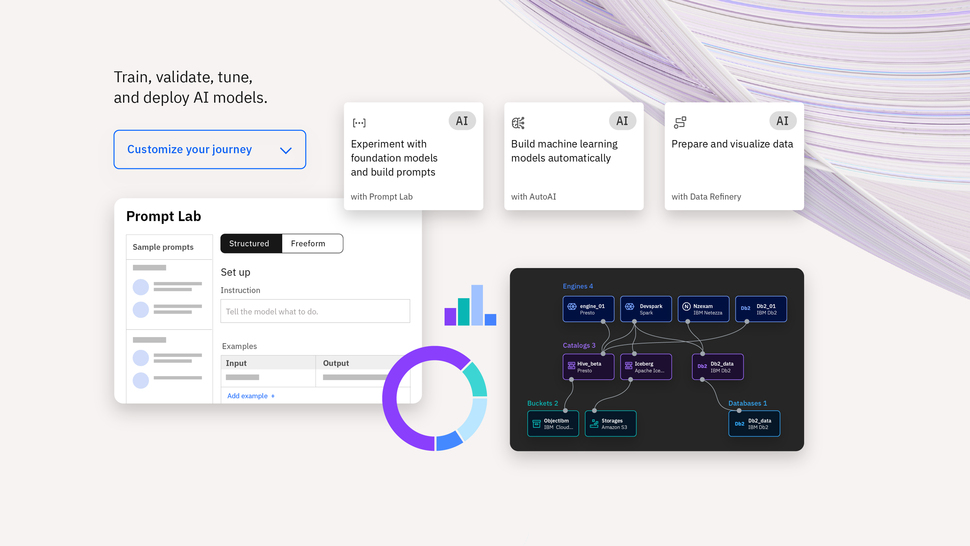
IBM watsonx.ai is our enterprise-ready next-generation studio for AI builders, bringing together traditional machine learning (ML) and new generative AI capabilities powered by foundation models. With watsonx.ai, businesses can effectively train, validate, tune and deploy AI models with confidence and at scale across their enterprise.
By supporting open-source frameworks and tools for code-based, automated and visual data science capabilities — all in a secure, trusted studio environment — we’re already seeing excitement from companies ready to use both foundation models and machine learning to accomplish key tasks.
“IBM’s launch of watsonx was an awakening, and it has inspired us to deliver unprecedented innovations for our clients.” Sean Im, CEO, Samsung SDS America
“In the field of generative AI and foundation models, watsonx is a platform that will enable us to meet our customers’ requirements in terms of optimization and security, while allowing them to benefit from the dynamism and innovations of the open-source community.” Romain Gaborit, CTO, Eviden, an ATOS business
“We’re looking at the potential usage of Large Language Models. There are huge possibilities including connecting your controls to your internal policies.” Marc Sabino Head of Innovation, MD Citi Internal Audit
What capabilities are included in watsonx.ai?
To help our clients take advantage of AI, we built a family of foundation models of different sizes and architectures, and carefully selected open-source generative AI models. Each IBM-trained foundation model brings together cutting-edge innovations from IBM Research and the open research community. These models have been trained on IBM curated datasets that have been mined to remove hateful, abusing and profane text (HAP).
With multiple families in plan, the first release is the Slate family of models, which represent an encoder-only architecture. These encoder-only architecture models are fast and effective for many enterprise NLP tasks, such as classifying customer feedback and extracting information from large documents. While they require task-specific labeled data for fine tuning, they also offer clients the best cost performance trade-off for non-generative use cases. These Slate models are fine-tuned via Jupyter notebooks and APIs.
To bridge the tuning gap, watsonx.ai offers a Prompt Lab, where users can interact with different prompts using prompt engineering on generative AI models for both zero-shot prompting and few-shot prompting. This allows users to accomplish different Natural Language Processing (NLP) functional tasks and take advantage of IBM vetted pre-trained open-source foundation models. Encoder-decoder and decoder-only large language models are available in the Prompt Lab today.
Capabilities within the Prompt Lab include:
Summarize: Transform text with domain-specific content into personalized overviews and capture key points (e.g., sales conversation summaries, insurance coverage, meeting transcripts, contract information)
Generate: Generate text content for a specific purpose, such as marketing campaigns, job descriptions, blogs or articles, and email drafting support.
Extract: Analyze existing unstructured text content to surface insights in specialized domain areas, such as audit acceleration, SEC 10K fact extraction and user research findings.
Classify: Read and classify written input with as few as zero examples, such as sorting of customer complaints, threat and vulnerability classification, sentiment analysis, and customer segmentation.
Question & Answering: Based on a set of documents or dynamic content, create a question-answering feature grounded on product specific content, such as building a Q&A resource from a broad knowledge base to provide customer service assistance.
Our viewpoint is that a single foundation model will not be the best fit for the wide range of enterprise use cases. That’s why we’re initially releasing five open-source models as part of the Prompt Lab sourced from Hugging Face, which can also be authored by third parties.
The models being released in the Prompt Lab include:
Subsequent watsonx.ai releases will include capabilities for prompt tuning and fine-tuning models as part of our Tuning Studio, as well as access to a greater variety of IBM-trained proprietary foundation models for efficient domain and task specialization.
Within watsonx.ai, users can take advantage of open-source frameworks like PyTorch, TensorFlow and scikit-learn alongside IBM’s entire machine learning and data science toolkit and its ecosystem tools for code-based and visual data science capabilities. Data scientists, data engineers, and developers can work with Jupyter notebooks and CLIs in programming languages they are familiar with, such as Python and R, to deploy the pre-trained machine learning model for various Natural Language Processing (NLP) use cases, including complaint analysis using tone or emotion classification, entity extraction on financial complaints, and sentiment model analysis.
Additional capabilities of our ML and data science toolkit include:
MLOps pipelines: Offers a collaborative studio for data scientists to build, train and deploy machine learning models with advanced features like automated machine learning and model monitoring. Allows users to manage their models throughout the development and deployment lifecycle.
Decision optimization: Provides the industry-leading solution engines for mathematical programming and constraint programming to solve your optimization use cases with a choice of notebook or visual programming interfaces.
Visual modeling: Delivers easy-to-use workflows for data scientists to build data preparation and predictive machine learning pipelines that include text analytics, visualizations and a variety of modeling methods.
Automated development: Automates data preparation, model development, feature engineering and hyperparameter optimization using AutoAI.
What is watsonx.data?
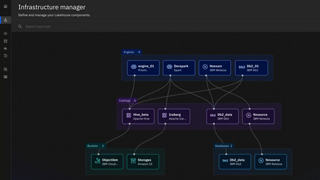
IBM watsonx.data is a fit-for-purpose data store built on an open lakehouse architecture. It is supported by querying, governance, and open data formats to access and share data across the hybrid cloud. Through workload optimization across multiple query engines and storage tiers, organizations can reduce data warehouse costs by up to 50 percent.1 Watsonx.data offers built-in governance and automation to get to trusted insights within minutes, and integrations with existing databases and tools to simplify setup and user experience. Later this year, it will leverage watsonx.ai foundation models to help users discover, augment, and enrich data with natural language.
Whether optimizing data warehouse workloads with multi-engine support or modernizing data lakes with high performance, governance and security, we are already seeing excitement from customers using watsonx.data as a new data foundation to accelerate their AI and analytics initiatives.
AMC Networks is excited by the opportunity to capitalize on the value of all of their data to improve viewer experiences.
“Watsonx.data could allow us to easily access and analyze our expansive, distributed data to help extract actionable insights.” Vitaly Tsivin, EVP Business Intelligence at AMC Networks.
STL Digital (STLD), the strategic IT partner of the Vedanta group, a global natural resources company, sees the potential of watsonx in driving the organization’s digital transformation:
“The power of watsonx.ai models, combined with the ability to leverage governed data in watsonx.data, enables our teams to build, train, tune, and deploy custom models at scale.” Raman Venkatraman, CEO of STL Digital
Watsonx.data is truly open and interoperable. It uses not just open-source technologies, but those with open governance and broad and diverse communities of users and contributors, like Apache Iceberg and Presto which is hosted by the Linux Foundation. Watsonx.data is also engineered to use Intel’s built-in accelerators on Intel’s new 4th Gen Xeon Scalable Processors, and uses multiple open-source query engines such as Presto and Spark. This provides for a breadth of workload coverage ranging from data exploration and transformation to analytics, BI and AI model training and tuning.
“We look forward to partnering with IBM to optimize the watsonx.data stack and contributing to the open-source community.” Das Kamhout, VP and Senior Principal Engineer of the Cloud and Enterprise Solutions Group at Intel
Watsonx.data supports our customers’ increasing needs around hybrid cloud deployments and is available on premises and across multiple cloud providers, including IBM Cloud and Amazon Web Services (AWS). Integrations between watsonx.data and AWS solutions include Amazon S3, EMR Spark, and later this year AWS Glue, as well as many more to come.
“Making watsonx.data available as a service in AWS Marketplace supports our customers’ increasing needs around hybrid cloud.” Soo Lee, Worldwide Strategic Alliances Director at AWS
Integration with watsonx.data also enables existing IBM Db2 Warehouse and Netezza customers to achieve a unified view of their analytics and AI estate. The next generation of Db2 Warehouse SaaS and Netezza SaaS on AWS fully support open formats such as Parquet and Iceberg table format, enabling the seamless combination and sharing of data in watsonx.data without the need for duplication or additional ETL. Watsonx.data allows customers to augment data warehouses such as Db2 Warehouse and Netezza and optimize workloads for performance and cost. Moreover, watsonx.data simplifies the process of combining new data from various sources with existing mission-critical data residing in on-premises and cloud repositories to power new insights.
“Building on our already existing Netezza workloads… we’re excited to see how watsonx can help us drive predictive analytics, identify fraud and optimize our marketing.” Bahaa’ Awartany, Chief Data Officer, Capital Bank of Jordan
We are primarily seeing customer adoption of watsonx.data across 4 key use cases:
AI/ML at scale: Build, train, tune, deploy, and monitor trusted AI/ML models for mission critical workloads with governed data in watsonx.data and ensure compliance with lineage and reproducibility of data used for AI.
Real-time analytics and BI: Combine data from existing sources with new data to unlock new, faster insights without the cost and complexity of duplicating and moving data across different environments.
Streamline data engineering: Reduce data pipelines, simplify data transformation, and enrich data for consumption using SQL, Python, or an AI infused conversational interface.
Responsible data sharing: Enable self-service access for more users to more data while ensuring security and compliance through centralized governance and local automated policy enforcement.
What capabilities are included in watsonx.data?
Our approach to an open data lakehouse architecture combines the best of IBM with the best of open source. Capabilities within watsonx.data include:
Multi-cloud, hybrid cloud availability: Supporting both SaaS and self-managed software deployment models, or a combination of both, providing another dimension of cost optimization.
Presto engine: Incorporates the latest performance enhancements to the Presto (link resides outside ibm.com) query engine. Presto is an open-source, fast, reliable, and highly scalable SQL query engine and is contributed to by some of the biggest companies in the world including Meta, Uber, Intel, and more.
Multi-engine integration: Eliminate the need to keep multiple copies of data for various workloads or across database and data lake repositories for analytics and AI use cases. Presto, Apache Spark, Db2, and Netezza engines are fully integrated with shared metadata and data storage and work off Iceberg table format to access and query a single copy of data across the multiple engines.
Open data and table format support: Store vast amounts of data in vendor-agnostic open formats, such as Parquet, Avro, and Apache ORC, while leveraging Apache Iceberg table format to share large volumes of data through an open table format built for high performance analytics.
Enterprise compliance and security: Protect data, manage compliance, and maintain trust with built in-governance, automation, and enterprise security capabilities, and fit seamlessly into a data fabric architecture with the Cloud Pak for Data and IBM Knowledge Catalog integration.
Easy to use, integrated data console: Bring your own data and stay in control of your data. In a few clicks, users can connect to existing analytics environments and start deploying fit-for-purpose query engines with integrated metadata and storage through a single point of entry. Seamlessly connect watsonx.data with various object storage such as AWS S3 or IBM Cloud object storage and registered databases such as MongoDB, MySQL, PostgreSQL, and more.
IBM Ecosystem integrations: Providing robust integration with IBM’s ecosystem to allow users to seamlessly realize the benefits of existing IBM investments and streamline the flow of data and information between products with seamless integration for IBM Db2 Warehouse, Netezza Performance Server, IBM zSystems, and Cognos Analytics, with DataStage, IBM Knowledge Catalog, Databand.ai, and Watson Studio integrations coming later this year.
Insights powered by generative AI: Later this year, users will be able to use natural language to explore, augment, and enrich data from a conversational user interface.
How you can get started today
Test out watsonx.ai and watsonx.data for yourself with our watsonx trial experience.
For watsonx.ai, our new AI studio to support both machine learning and generative AI use cases, anyone can take advantage of watsonx.ai for free. Within the watsonx.ai trial, you get access to features such as 50K inference tokens, per user, per month, to play around with different sample prompts in the Prompt Lab.
With our free watsonx.data trial, you’ll receive USD 1,500 in free IBM Cloud credits to test drive a watsonx.data instance. You will be able to experience core capabilities such our multiple engines, support for open formats, built-in governance, and querying.
In the high-octane world of mixed martial arts, storytelling is everything. For the UFC, delivering real-time insights and compelling narratives across more than 40 live events isn’t just a content challenge; it’s a business imperative.
But as the organization embraced generative AI and agentic systems to automate and scale its storytelling, new challenges emerged: Could AI misrepresent fighters or introduce bias? Would generated content be explainable and auditable? How could UFC ensure compliance with emerging AI regulations?
Agentic AI, which enables autonomous decision-making and task execution, is transforming industries. By 2028, Gartner predicts that one third of enterprise interactions will involve agentic AI systems. But with autonomy comes complexity. Risks like hallucinations, bias, untraceable actions and security vulnerabilities are no longer theoretical—they are operational threats.
By focusing on quality AI governance, the UFC prevents flaws and promotes integrity as it scales agentic AI use.
Behind the scenes: How governance powers UFC’s AI storytelling
While the UFC Insights Engine impresses audiences with real-time narratives and lively fight analysis, its credibility depends on what happens behind the scenes. IBM® watsonx.governance® helps guarantee that every insight is accurate, fair and explainable.
Take, for example, the model management and explainability layer. Large language models like Granite and Llama power UFC’s fight insights. These models generate fast, engaging content, but speed alone isn’t enough. To help promote trustworthy storytelling, watsonx.governance reviews their outputs to detect bias, validate quality and ensure transparency.
Beyond content quality, governance also enables feature influence analysis. When AI predicts a fight outcome, watsonx.governance helps explain which statistics (like striking accuracy or takedown defense) tipped the scales. This builds confidence in the predictions and deepens fan engagement by showing the logic behind the matchups.
And while UFC doesn’t directly manage the governance infrastructure, it benefits from IBM’s implementation. Automated documentation and metadata capture support audit readiness, reinforcing the system’s integrity.
Looking ahead, UFC is exploring ways to deepen the integrity of its AI-generated narratives. It does that by extending governance beyond model outputs to the storytelling itself. By applying the watsonx.governance SDK to fight narratives, the organization aims to introduce new layers of content safety and editorial accountability. This process helps ensure a standard of credibility in UFC’s AI-powered storytelling.
Why governance is the new MVP
The UFC Insights Engine achieved a 3x increase in insight volume and an estimated 40% reduction in query generation time, but these gains would be meaningless without trust. With watsonx.governance, UFC ensures that every AI-generated story aligns with its brand values, editorial standards and legal obligations.
It isn’t just about sports—it’s a blueprint for any organization scaling agentic AI.
Recent surveys show that 82% of governance teams are modernizing their frameworks to keep pace with AI. Legacy oversight models are breaking under the speed and scale of autonomous systems. UFC’s approach of embedding governance from the start reflects a broader industry shift from gatekeeping to enablement.
As AI becomes more agentic, governance must become more proactive, automated and integrated.
Final bell: Responsible AI is a competitive advantage
UFC’s story is a powerful reminder that scaling AI isn’t just about performance; it’s about responsibility. By integrating watsonx.governance into its AI stack, UFC safeguarded its automated storytelling.
For tech leaders navigating the agentic AI era, governance isn’t a constraint—it’s your competitive edge.
Artificial intelligence adoption is accelerating fast. Banks, credit unions, insurers and investment firms are moving quickly from pilots to real-world use cases such as fraud detection, credit decisioning, claims automation, portfolio insights and hyperpersonalized customer experiences. But with that momentum comes heightened scrutiny around model risk, data lineage and regulatory compliance. IBM’s watsonx platform can help.
About 42% of enterprises are actively using AI in their business, and 40% are experimenting with the technology, according to a recent IBM report. For financial institutions, those numbers reflect a clear pressure to innovate: regulators, auditors, boards and customers all want to understand how AI is being used and why it can be trusted.
But Divya Sridharabalan, worldwide sales leader for automation and AI at IBM, says it’s not consistent usage across the board: Just 20% are using AI for production workloads. So, why the gap? “It’s mainly because leaders lack trust and confidence in their models. Statistics tell us that 80% of business leaders see ethics as an issue moving from preproduction to production.”
In financial services, that “trust gap” is magnified by the stakes. Automated decisions may affect credit access, insurance pricing, trading behavior or anti-money laundering alerts. And because these domains are tightly regulated, the burden of proof for fairness, explainability, privacy and resilience is higher than in most other industries.
That’s why more business IT leaders are turning to IBM’s watsonx all-in-one platform, which can quickly build custom AI applications, manage all data sources and accelerate responsible AI workflows. Experts say it can also filter data safely, so teams get the most from AI tools while staying aligned with internal model risk management frameworks and external expectations.
Balancing the Risks and Rewards of AI in Finance
Survey data shows that business leaders are positive about the potential of AI. In related research conducted by CDW, more than half of respondents said their company is leveraging AI to improve cybersecurity (55%), speed up innovation (52%) and improve the customer experience (51%).
Risk reduction: Faster detection of fraud patterns, account takeover attempts and anomalous trading behavior
Operational efficiency: Automated document processing for onboarding, loan origination and claims, plus smarter routing of service requests
Decision velocity: Better and faster insights for underwriting, pricing, liquidity forecasting and compliance operations
But Sridharabalan also identifies three risks that can impact AI adoption: regulation, reputation and operation.
Regulation risks focus on compliance. For example, are AI operations aligned with industry, government and international expectations? In financial services, that means meeting stringent requirements for data residency, auditability, model explainability, consumer protection and third-party risk — often across multiple jurisdictions.
Reputational concerns are centered on data misuse. Even if this misuse is unintended and entirely accidental, it can negatively impact client and consumer perception. A single biased lending model or opaque underwriting decision can erode trust that took decades to build.
Operational risks are tied to the efficacy of AI deployments. If financial institutions have committed significant resources to AI but are stuck in preproduction, they stand to lose both time and money, and they run the risk of falling behind more agile competitors.
“If you put all of that together, compliance is the leading concern,” she says. “Businesses need to think about compliance and governance more proactively. As a result, we’re seeing a shift in the market.”
IBM’s watsonx AI Platform for Banks, Insurers and Investment Firms
IBM is no stranger to AI. “We’ve been in the field of cognitive solutions and AI for quite a few years,” says Sridharabalan. “We saw momentum with ChatGPT. Our watsonx AI and data platform enables customers and partners to develop, improve, and govern generative AI and machine learning models.”
For financial services IT leaders, that means you can pursue generative AI and ML initiatives without compromising the controls that regulators and your own risk teams require.
The watsonx platform follows suit with a sophisticated approach to AI that includes three core components:
Data: Data is a trusted lakehouse that lets companies access data where it lives. This approach is especially relevant for financial institutions dealing with data spread across core banking systems, claims platforms, trading environments, customer channels and compliance repositories. This arrangement can save companies up to 50% on data warehouse costs, Sridharabalan notes, while still supporting governance and lineage across structured and unstructured data.
AI: The platform is entirely customizable, so whatever financial institutions want to build — fraud models, credit risk scoring, claims triage, contact center copilots or investment research summarization — and however they want to build it, watsonx.ai can help. IBM experts are also there to guide IT leaders strategically. “Companies can use one of our foundational models,” says Sridharabalan. “They can also bring their own model to the platform. It’s completely open from that perspective.”
Governance: With watsonx.governance, organizations get oversight at the model lifecycle level. Risk can be understood and governed at each stage of development, deployment and production — aligning to banking and insurance MRM standards, internal audit requirements and emerging AI regulations.
Sridharabalan notes that it’s a priority for IBM to meet customers where they are.
“Watsonx is available both as on-premises software and as a service,” she says. “It’s built on RedHat OpenShift. Companies can deploy it in the cloud of their choice.”
For financial institutions, that flexibility supports:
Hybrid and multicloud strategies
Data residency and sovereignty requirements
Latency-sensitive workloads (such as real-time fraud scoring)
Clear separation between dev/test and regulated production environments
55%
The percentage of survey respondents using artificial intelligence to improve cybersecurity
Source: CDW, “2025 CDW Artificial Intelligence Research Report,” April 2025
Why watsonx.governance Gives Financial Teams More Confidence
Without a clear governance plan in place, no AI strategies will be successful — especially in regulated environments. Watsonx.governance (the governance component of the all-in-one platform) takes that guesswork out of the equation.
Financial institutions can:
Evaluate, track and document the history of machine learning model iterations to satisfy audit and validation needs.
Monitor models in production to ensure outputs remain valid and accurate as market conditions, fraud patterns or consumer behaviors change.
Evaluate models for potential bias — critical for fair lending, equitable insurance pricing and responsible wealth advice.
Automate retraining and review workflows based on production feedback, while keeping human risk oversight in the loop.
“Think of the watsonx platform as a vehicle to reach your desired outcomes,” says Sridharabalan. “Watsonx.ai is the accelerator. Watsonx.data is the fuel. And watsonx.governance is the safety features that keep you on track.”
For IT leaders in banking, credit unions, insurance and investment firms, that “safety features” layer is what unlocks scale: It helps teams move from promising pilots to confident production deployments, along with governance that stands up to regulators, auditors and the expectations of your customers.
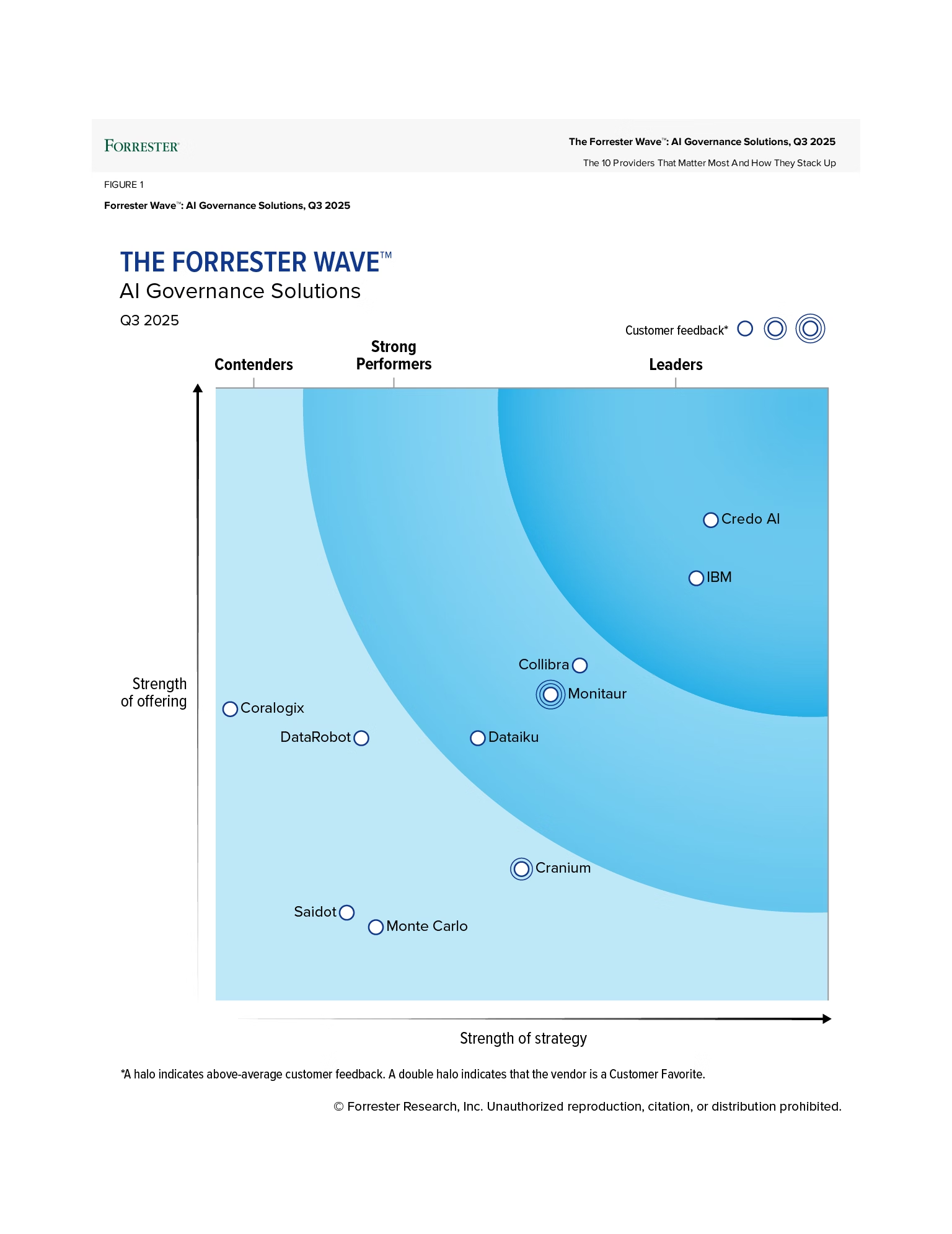
What's New: We are proud to announce that IBM has been named a Leader in The Forrester Wave™: AI Governance Solutions, Q3 2025 with watsonx.governance.
We are proud of this recognition; not just for the ranking, but because it reflects the work we’ve done with our customers to make AI safer, more transparent and more accountable.
Over the past decade, we’ve worked with organizations across many industries — especially highly regulated ones — to understand what responsible AI looks like in practice. That experience has shaped watsonx.governance into a solution that supports not only AI risk management and compliance, but also evaluation, observability, guardrails and lifecycle governance for AI systems.
As organizations face growing AI risks and regulations, along with pressure to unlock value from AI, our solution helps align technology, business, assurance, and security teams around consistent governance frameworks that turn principles into practice.
Why Forrester named IBM a Leader
Forrester recognized IBM for our ability to manage the complexity of AI governance across many roles and responsibilities. Our strategy reflects years of collaboration with customers in complex and highly regulated industries — and that experience is built into watsonx.governance.
Watsonx.governance supports key governance needs like policy management, auditability, and observability. It also includes new capabilities for agentic AI — helping teams govern an inventory of agents and tools, monitor agent behaviors, evaluate decision-making and detect risks like hallucinations.
Forrester also cited our solid vision, roadmap, and flexible packaging. We believe this recognition reflects our focus on practical, scalable governance for fast-evolving AI technologies.
Why AI Governance matters
AI governance isn’t a challenge for just one department; it requires collaboration across engineering, legal, compliance, risk, security, data and business teams. Our goal with watsonx.governance is to strengthen that collaboration by offering tools that support policy management, auditability and transparency throughout the AI lifecycle.
As IBM and other organizations invest more in AI governance, the perception of these solutions is changing. They’re no longer seen just as compliance tools or business costs, but as essential enablers for scaling AI and unlocking value from data. In fact:
27% of Fortune 500 companies cite AI regulation as a risk in their annual reports (WSJ/2024).
68% of CEOs we surveyed say governance for generative AI must be built into the design phase (IBV/2025).
65% of data leaders at a recent Gartner conference named data governance as their top focus for 2024 (IBV/2025).
We’ve also focused on preparing for and managing emerging risks. As AI systems become more autonomous — with agents making decisions, interacting with tools and taking actions independently — governance must evolve to ensure these agents follow business goals, policy standards and safety expectations
How we’re addressing agentic AI
We’ve added 3 new capabilities to help teams govern these agents more effectively:
Governed agentic catalog:
A centralized inventory of the tools and agents your teams use, enriched with governance metadata like ownership, descriptions and usage history. Users can compare assets side-by-side using evaluation metrics — such as quality, cost, latency and performance — to make better decisions about reuse and adoption, reducing the risk of unvetted or duplicate capabilities
Tool and agent evaluators:
Evaluators help measure the performance of your agentic application during development. Our SDK offers out-of-the-box metrics like faithfulness, context relevance, and answer relevance. These can be used in-the-loop (during the flow of the agent to control its logic or as decision points) or offline (after the agent flow to evaluate overall agent quality). This is available using a simple decorator-based approach using a single line to invoke the evaluator can be added to each node of the agent, making evaluation easy to implement. This helps developers build higher-quality applications that are more resilient, trustworthy and ready for validation and production.
Experimentation tracking:
Experimentation Tracking provides full visibility into how agents and tools perform over time — from development to deployment. Teams can log runs, compare outcomes and rank configurations using custom business, safety and quality metrics, making it easier to choose the best-performing approach based on metrics data.
What customers are telling us
Customers consistently say that watsonx.governance helps them scale AI with confidence. For example:
The United States Tennis Association (USTA) used watsonx to build generative AI features like Match Reports and AI Commentary for the US Open. They emphasized how governance tools helped ensure their models were performant, compliant, and aligned with editorial goals.
Deloitte highlighted how watsonx.governance supports responsible AI adoption, helping clients embed trust and transparency into their AI workflows.
Forrester’s report specifically notes that IBM customers appreciate “the ability to align technology, business, and risk and legal teams on policy and approvals” — a capability that’s becoming more critical as AI expands across organizations.
As these customers scale their AI efforts, they’re asking for deeper model risk assessments; feedback that’s actively shaping our product roadmap and future capabilities.
Looking ahead
As organizations look for practical ways to bring consistency, control, and visibility to agentic development, demand for our Governed Agentic Catalog continues to grow. It helps teams manage tool usage, lineage, and reuse across projects — making it easier to scale responsibly while maintaining oversight. Production monitoring and Guardrails for agentic AI are also in demand and we have new features on our roadmap to address these areas.
Governance isn’t just about compliance — it’s about the efficient, safe and trusted use of technology like artificial intelligence. As Forrester recognized in naming IBM a Leader, our experience working with clients in complex and regulated industries has shaped a solution that meets today’s AI governance challenges and prepares for tomorrow’s.
As AI continues to evolve, we’re committed to helping our customers stay ahead of risks while unlocking the value of these technologies. watsonx.governance was built with real-world complexity in mind, with automation to scale and a roadmap shaped by the practical needs of organizations implementing responsible AI.
Global technology group e& and IBM announced a strategic collaboration to advance towards an enterprise-grade agentic AI foundation at e&, starting with policy, risk, and compliance. Unveiled at the World Economic Forum Annual Meeting in Davos, the initiative reflects e&’s move beyond traditional natural language processing (NLP)-based chatbots toward governed, action-oriented AI embedded in core enterprise systems.
e& and IBM have introduced an agentic AI solution built on IBM watsonx Orchestrate – a product offering more than 500 tools and customizable, domain-specific agents from IBM and its partners – to help employees and auditors quickly access and interpret legal, regulatory, and compliance information. Integrated with IBM OpenPages and the broader watsonx portfolio, the solution delivers clear, traceable responses aligned with enterprise governance requirements.
e& and IBM unveil enterprise-grade agentic AI at the World Economic Forum in Davos. Ana Paula Assis, SVP and Chair for Europe, the Middle East, Africa, and Asia Pacific, IBM and Hatem Dowidar, Group CEO, e&
A joint proof of concept delivered by IBM, GBM (Gulf Business Machines) and e& within eight weeks demonstrated how agentic AI can operate at enterprise scale under real-world conditions.
IBM watsonx Orchestrate enables agentic AI that goes beyond chat-based interactions, allowing AI agents to reason, orchestrate tasks, and integrate with enterprise systems under governance controls. For e&, it provides a foundation for trusted, explainable AI that can scale across compliance and other enterprise domains. It helps to streamline compliance tasks, reduce response times, and enable 24/7 self-service access across the organization.
The initiative also aligns natively with watsonx.governance, already in use at e&, providing a strong foundation for AI governance, explainability, and compliance by design. By embedding agentic AI directly into the OpenPages governance, risk, and compliance platform, this represents one of the early enterprise-grade agentic AI implementations in the region, demonstrating how AI can support trusted, human-led decision-making under regulatory and operational requirements.
The deployment also demonstrates the flexibility of IBM’s AI and model gateway approach, enabling large language models to run across hybrid environments, including customer-managed infrastructure, while remaining governed under enterprise controls.
This collaboration marks an important milestone in e&’s enterprise AI journey, establishing a scalable and governed foundation for agentic AI adoption across the organization. By embedding action-oriented AI directly into core governance and compliance workflows, e& is reinforcing its commitment to responsible innovation and setting a new benchmark for trusted, enterprise-grade agentic AI in the region.
Hatem Dowidar, Group CEO, e&
Our ambition is to move beyond isolated AI use cases toward enterprise-scale agentic AI that is trusted, governed, and deeply integrated into how the organization operates. By collaborating with IBM, we are embedding intelligence directly into our risk and compliance processes, enabling faster decisions, consistent policy interpretation, and a foundation for broader agentic AI adoption across the enterprise.
Ana Paula Assis, SVP and Chair for Europe, the Middle East, Africa, and Asia Pacific, IBM
As organizations move from experimenting with AI to embedding it into the fabric of how they operate, governance and accountability become just as important as intelligence. Through our collaboration with e&, this proof of concept intends to demonstrate how agentic AI can be designed and validated for enterprise-scale use, deeply integrated into core systems, governed by design, and trusted to support human-led decisions and outcomes.
watsonx Orchestrate: Enterprise-Grade AI Automation for Intelligent Workflow Execution
From Automation to Intelligent Orchestration
Modern enterprises operate across highly distributed environments that include cloud platforms, microservices, AI systems, SaaS applications, and operational tooling. As a result, work increasingly spans multiple systems, requiring significant cognitive effort from employees to coordinate tasks, manage dependencies, and execute processes reliably.
Traditional automation tools focus on scripted workflows — but they lack contextual understanding, adaptability, and reasoning.
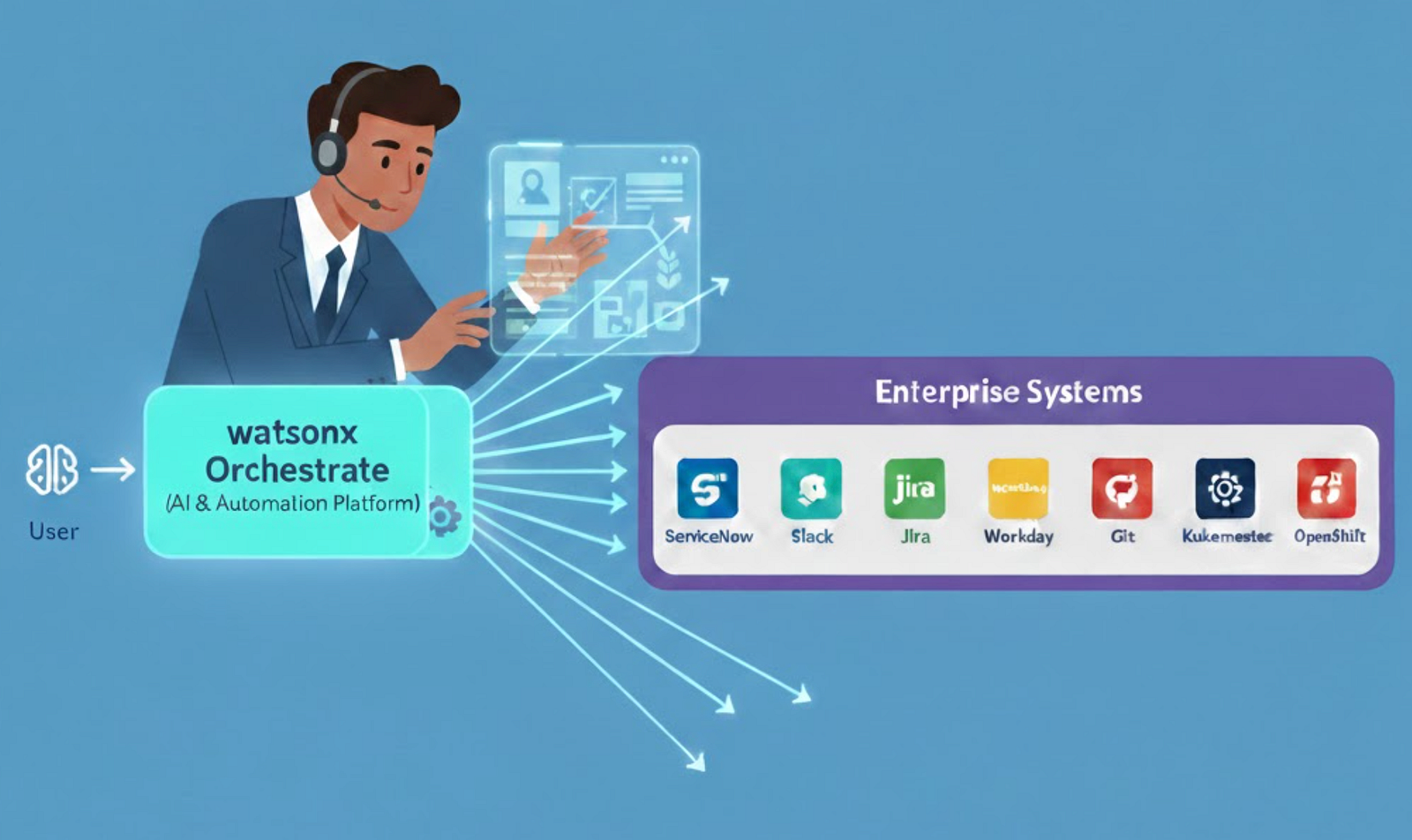
watsonx Orchestrate addresses this gap by combining large language models (LLMs), enterprise integrations, and workflow orchestration to create an intelligent automation layer that can interpret natural language requests and execute multi-step actions across systems.
Instead of users navigating multiple tools and manually coordinating actions, watsonx Orchestrate serves as an AI-powered control plane for enterprise operations.
What is watsonx Orchestrate?
watsonx Orchestrate is an AI-driven automation platform that enables:
Intent recognition from natural language
Dynamic task decomposition
Automated execution across enterprise tools
Context-aware decision-making
Continuous learning from past interactions
It functions as a middleware layer that bridges human intent with machine execution across IT, business, and operational domains.
Rather than requiring users to know exact workflows, commands, or system interfaces, they can express goals in natural language and rely on Orchestrate to determine the optimal sequence of actions.
Example request:
“Create a high-priority incident for the production outage, notify the SRE team, and summarize recent deployment changes.”
watsonx Orchestrate can:
Create a ServiceNow ticket
Assign severity based on impact
Notify stakeholders in Slack
Retrieve relevant Git commits
Provide a structured incident summary
This represents a shift from scripted automation to AI-mediated orchestration.
Core Architecture of watsonx Orchestrate
1. Cognitive Layer — AI and Language Processing
At the core of watsonx Orchestrate is a large language model that:
Interprets user intent
Extracts entities and constraints
Determines necessary actions
Selects appropriate tools
Handles ambiguity through clarification loops
This layer transforms human language into structured, machine-readable tasks.
The orchestration engine serves as the operational backbone of watsonx Orchestrate, responsible for intelligently sequencing tasks, managing dependencies between components, and coordinating actions across multiple systems. It ensures reliable execution by handling failures through automated retries and remediation, while maintaining consistency and governance throughout the workflow. By integrating and synchronizing activities across diverse platforms, the orchestration engine enables scalable, resilient, and well-coordinated enterprise automation.
It enables complex workflows such as:
Multi-step approvals
Conditional logic
Parallel execution
Error remediation
This makes Orchestrate suitable for enterprise-scale operations rather than simple task automation.
3. Integration Layer — Connectors and APIs
watsonx Orchestrate integrates with enterprise systems including:
ServiceNow
Jira
Slack / Microsoft Teams
Salesforce
Workday
GitHub / GitLab
Kubernetes / OpenShift
IBM Cloud Pak
CI/CD pipelines and many more…
These integrations allow Orchestrate to not only analyze data but also execute real-world actions within production environments.
Use Case — Intelligent HR Onboarding Automation
New employee onboarding involves multiple teams and systems, including:
Identity provisioning
Access management
Device setup
Application permissions
Communication tools
With watsonx Orchestrate, an HR request such as:
“Onboard David to the Marketing team starting Monday.”
Can automatically:
Create Active Directory credentials
Assign role-based access
Request hardware provisioning
Configure Slack and email
Schedule onboarding sessions
This transforms onboarding from a multi-day manual process into an automated, repeatable workflow.
Enterprise Value of watsonx Orchestrate
1. Standardized Operations: Automated workflows ensure consistency across teams and environments
2. Increased Productivity: Employees spend less time navigating systems and more time making strategic decisions.
3. Reduced Cognitive Load: Users no longer need to memorize complex procedures or tool-specific commands.
4. Improved Reliability: AI-assisted orchestration reduces human error in critical workflows.
Integration with the IBM Ecosystem
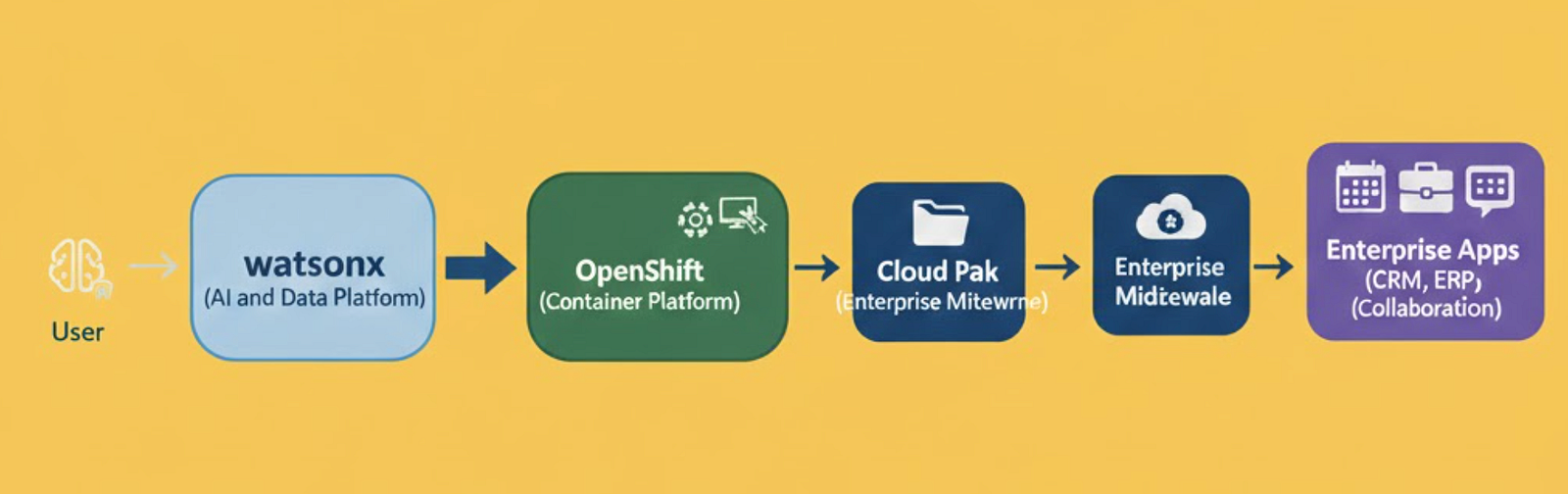
watsonx Orchestrate integrates natively with:
watsonx.ai for advanced AI capabilities
Red Hat OpenShift for container orchestration
IBM Cloud Pak for enterprise middleware
Enterprise SaaS and IT systems
This makes it well-suited for regulated industries such as:
Financial services
Healthcare
Government
Manufacturing
Future of Intelligent Orchestration
Looking ahead, the future of intelligent orchestration with watsonx Orchestrate will be defined by greater autonomy, resilience, and domain specialization. The platform is evolving toward department-specific AI agents, self-healing workflows, predictive automation, and autonomous remediation, all supported by deeper integration with observability tools. This will enable dedicated AI agents tailored for DevOps, IT operations, HR, Finance, and Security — each optimized for its unique workflows and operational needs. Together, these advancements will move enterprises closer to truly intelligent, proactive, and self-managing systems that not only respond to issues but anticipate and prevent them.
Conclusion
watsonx Orchestrate represents a fundamental shift from:
“Manual tool-based work” to — “AI-mediated enterprise operations.”
Rather than replacing human decision-making, it enhances it by automating execution while preserving strategic oversight.
IBM heeft aangekondigd DataStax over te nemen. DataStax is de ondersteuner van de Apache Cassandra-database en heeft recent het bereik uitgebreid naar streaming data en generatieve AI. IBM noemde de mogelijkheden van DataStax om ongestructureerde data te beheren en haar vectordatabase, die wordt gebruikt voor het ontwikkelen van RAG-oplossingen. De technologie van DataStax zal IBM’s watsonx portfolio van producten die het gebruik van generatieve AI versnellen, versterken en bedrijven helpen waarde te ontsluiten uit enorme hoeveelheden ongestructureerde data.
De overname bouwt ook voort op IBM’s toewijding aan open source AI. DataStax is de maker van AstraDB en DataStax Enterprise, NoSQL en vector database mogelijkheden aangedreven door Apache Cassandra; en Langflow, de open source tool en community voor low-code AI applicatie-ontwikkeling.
Apache Cassandra werd oorspronkelijk in 2008 bij Facebook ontwikkeld om te voorzien in de behoefte van het sociale netwerk aan een zeer schaalbare, fouttolerante database om grote gegevens op te slaan die door gebruikers op de website werden gegenereerd. Cassandra, technisch gezien een wide-column store die de beschikbaarheid en betrouwbaarheid van gegevens bevordert, werd een top-level project bij de Apache Software Foundation in 2010. In datzelfde jaar richtten Jonathan Ellis en Matt Pfeil in Austin, Texas, het bedrijf Riptano op, dat al snel werd omgedoopt tot DataStax.
IBM zal de open source Apache Cassandra, Langflow, Apache Pulsar en OpenSearch gemeenschappen waarin DataStax participeert blijven ondersteunen, betrekken en innoveren. IBM’s langdurige betrokkenheid bij open source AI omvat de open-source IBM Granite foundation modellen en Instruct Lab, een revolutionaire aanpak om echte open source innovatie rond LLM’s te bevorderen.
Ritika Gunnar, General Manager, Data and AI bij IBM, geeft in een blogpost meer achtergronden over de acquisitie. “Ongestructureerde data vertegenwoordigen een schat aan onaangeboorde Business Intelligence en vertegenwoordigen volgens IDC 93 procent van alle bedrijfsdata in 2024. Het benutten van de kracht van deze data binnen generatieve AI-toepassingen is essentieel. Maar daarvoor moeten bedrijven eerst orde scheppen in de chaos van data.” Volgens Gunnar wil IBM het open source-aanbod van DataStax samenbrengen met het watsonx-portfolio van producten, gebaseerd op Apache Iceberg, Apache Spark, Velox en Presto, om klanten te helpen grote hoeveelheden ongestructureerde data te benutten.
Financiële details van de transactie zijn niet bekendgemaakt. De overname zal naar verwachting in het tweede kwartaal van 2025 worden afgerond, afhankelijk van de gebruikelijke voorwaarden en goedkeuringen van regelgevende instanties.
IBM biedt Watsonx aan als platform waarop bedrijven op een veilige manier met AI-modellen aan de slag kunnen. Met unieke features en brede compatibiliteit hoopt het de concurrentiestrijd met onder andere Google, OpenAI en Nvidia te winnen. Wat is Watsonx, wat kan het en waarom zou een organisatie juist IBM’s platform kiezen?
Watsonx is al sinds mei bekend, maar met Watsonx Your Business is er voor het eerst een advertentiecampagne voor op poten gezet door IBM. Klaarblijkelijk hebben organisaties meer duidelijkheid nodig over de potentie van AI en hoe het praktisch toe te passen is. De twee advertenties sporen bedrijven aan om hun organisaties te “Watsonx“-en. Als hoofdpunten geeft men aan hoe belangrijk het is om AI-modellen met eigen data te trainen en om allerlei alledaagse taken bij werknemers weg te nemen.
Druk speelveld
Er zijn verschillende concepten rondom de inzet van AI voor bedrijven: zo zijn er kant-en-klare plugins voor bijvoorbeeld ChatGPT om snel een chatbot in te kunnen zetten met zo min mogelijk moeite. Echter lijkt de stap ook bij OpenAI inmiddels gemaakt te zijn naar trusted data en eigen modellen: met ChatGPT Enterprise kunnen organisaties de kracht van GPT-4 inzetten met eigen bedrijfsdata voor specifieke doeleinden. Privacy zou geen probleem moeten zijn: de data en outputs worden niet door OpenAI ingezet voor verdere training.
Ook IBM komt met soortgelijke beloftes: privacy staat hoog in het vaandel, net als het trainen van modellen op eigen data. Elders zien we soortgelijke ontwikkelingen: Google heeft een AI-pakket waarbij klanten gelijk 100 LLM’s tot hun beschikking krijgen en ze kunnen trainen met interne enterprise-data. Ook VMware en Nvidia sloegen de handen ineen met de Private AI Foundation, dat eveneens menig AI-model beschikbaar stelt voor talloze use cases. Zo is het aanbod van alle kanten steeds meer gelijkgeschakeld, maar wat maakt Watsonx bijzonder?
Watsonx.ai en Watsonx.data
Het IBM-aanbod dat lijkt op het bovenstaande, is samen te vatten onder de noemer Watsonx.ai. Zelf haalt het bedrijf juist Watsonx.data aan als unieke troef: het zou hier gaan om de enige data store binnen de industrie die open, hybride en governed is. Omdat de data-explosie van geen ophouden weet, stelt IBM dat er voor AI-workloads een specifieke data-oplossing vereist is die daarop inspeelt. Men belooft dat alle data via een gedeelde metadata-laag behoort die ook geldt voor meerdere cloud-omgevingen en on-prem. Ingebouwde governance, security en automatisering zou ervoor moeten zorgen dat storage- en analytics-omgevingen met het dataplatform verbonden kunnen worden.
Doordat Watsonx.ai en Watsonx.data nadeloos op elkaar aansluiten, moet het mogelijk zijn om alle data en metadata te kunnen analyseren, visualiseren en transformeren met de AI-modellen die IBM aanbiedt en die bedrijven zelf creëren. Uiteindelijk is het deze snel werkende integratie van AI-platform met zoveel mogelijk data cruciaal. Wat dat betreft heeft IBM een helder verhaal klaar staan: wie beide Watsonx-producten combineert, kan snel en eenvoudig aan de slag met AI.
Concreet: hulp bij COBOL
IBM kwam onlangs nog met een unieke toepassing van een dergelijk AI-platform: Code Assistant for Z. Mainframes zijn nog vaak gecodeerd in COBOL, een programmeertaal die maar weinig ontwikkelaars kennen. Daarmee is de mankracht er wel mee overweg kan erg duur: wat als AI dat probleem kan verhelpen?
Watsonx Code Assistant for Z belooft daarom COBOL-code om te zetten naar het alom bekende Java. Zo hoeven organisaties na de AI-vertaling minder te vrezen voor het onderhoud van mainframes. Aangezien COBOL nog altijd ingezet wordt voor kritieke bedrijfsprocessen, is een dergelijke toepassing een helder voorbeeld van wat generatieve AI mogelijk maakt.
Unlock the full potential of watsonx for your organisation.
Discover how IBM’s AI portfolio helps you accelerate innovation, streamline workflows and build trusted AI solutions at scale.
Accelerate development with AI-driven automation
Build secure and governed AI solutions
Deploy across hybrid and multi-cloud environments
Scale agentic AI confidently in production
Ready to explore what watsonx can mean for your organisation?
Our IBM specialists at Copaco Cloud are happy to walk you through the possibilities, discuss relevant use cases and help you define the right next step.
Leave your phone number and we’ll get back to you within 24 hours.
Get in touch
Travel toData Universe
Agents Universe
Lorem ipsum dolor sit amet consectetur adipisicing elit. Quos, iste! Atque eum accusamus aperiam, rem unde, reprehenderit reiciendis consequuntur temporibus veritatis, adipisci blanditiis laudantium velit est quaerat? Debitis, vero dolores?
Travel toModels Universe
All Topics
Explore Articles
Welcome
John Doe
Discover how Watsonx can help you turn AI into practical value. Explore relevant insights, use cases and solutions tailored to your interests.
What are your interests?
Select the topic you are interested in
×
Agents
Laden...
...
watsonx chat
Powered by Copaco
Hello! Welcome to watsonx chat. How can we help you today?
Just now
Get in touch
Thank you for your request! We have received your request and will contact you within 24 hours.
Your request could not be sent. Please try again, or contact our team using the details alongside this form.
















 Accelerate development with AI-driven automation


